Trainer, Behaviorist, or Veterinary Behaviorist — What's the Actual Difference?
Category: Selecting a Trainer
These three titles get used almost interchangeably by pet owners, and that confusion has real consequences. The American College of Veterinary Behaviorists (ACVB) draws a hard, legally-backed line that's worth understanding before you're in a situation where it matters.
"Behaviorist" is a protected term — but only for veterinarians
Per the ACVB, veterinarians may only call themselves "behaviorists" if they've achieved board certification through the ACVB. There are no equivalent restrictions on trainers or anyone else — meaning a dog trainer can legally call themselves a "behaviorist" with zero formal education, while a Diplomate of the ACVB has completed a full residency or training program covering sociobiology, the psychology of learning, behavioral genetics, behavioral physiology, psychopharmacology, ethology, and behavioral endocrinology.
What a board-certified veterinary behaviorist can do that a trainer legally cannot
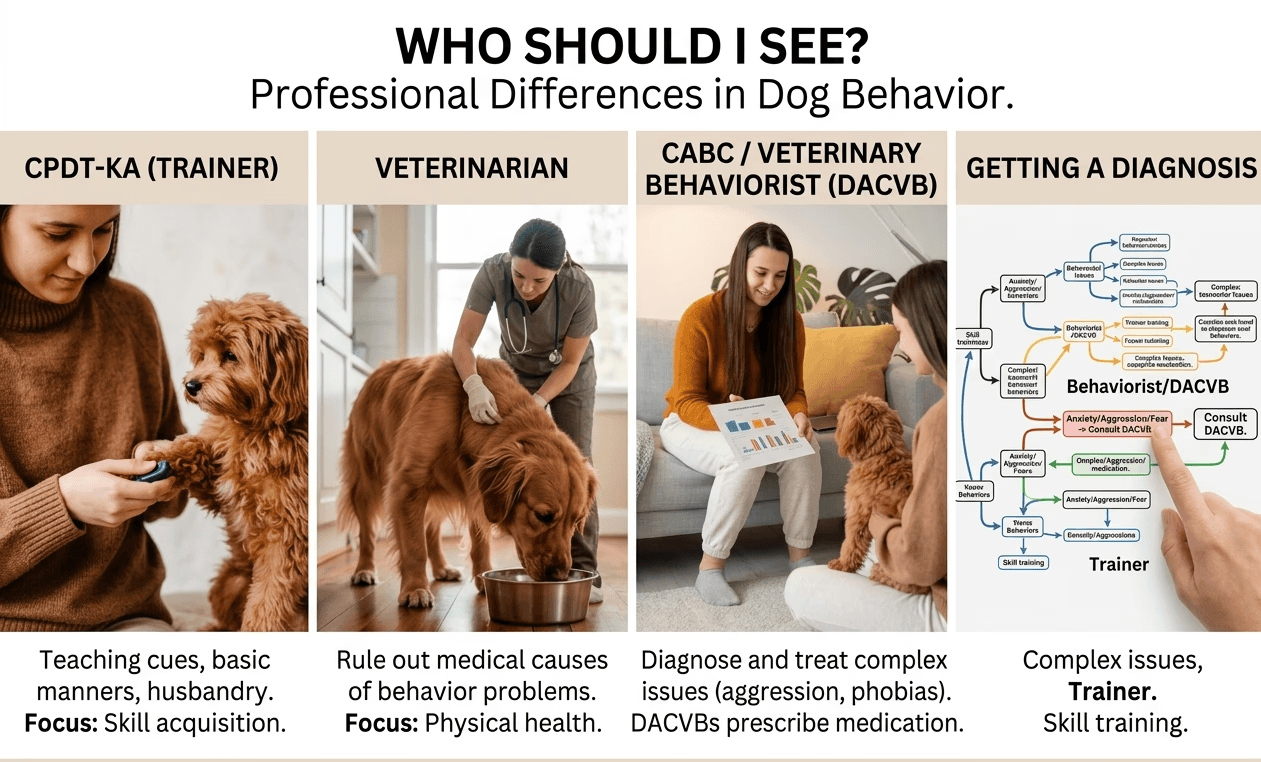
Specialists in veterinary behavioral medicine combine medical and behavioral knowledge to determine whether a medical issue is contributing to a behavior problem, and to decide which medication, if any, belongs in an integrated treatment plan alongside behavior modification. Critically, only a veterinarian can diagnose a physical or mental health condition in a dog, or prescribe behavior medication. A trainer — however experienced — cannot legally do either.
Why "taking a good history" is a specific, trained skill
The ACVB specifically calls out something easy to overlook: the ability to take a detailed behavioral and medical history, filter out irrelevant information, and build a treatment plan on the facts that actually matter is a distinct skill, not a given.
Accountability matters too
Veterinary behaviorists operate under a real regulatory structure — ACVB standards are approved by the American Board of Veterinary Specialties (ABVS), itself part of the American Veterinary Medical Association (AVMA), and specialists are additionally accountable to state veterinary practice laws. A trainer, by contrast, answers to no equivalent body.
What this means for you as an adopter: for manners, basic obedience, or puppy socialization, a well-credentialed trainer is exactly the right resource. But if your dog is showing real fear, anxiety, or aggression — especially anything involving a bite or a medical question mark — a board-certified veterinary behaviorist is the professional actually qualified to diagnose and treat it, not a title anyone can self-apply.
Source: DACVB — Why Seek Help from a Board-Certified Veterinary Behaviorist
